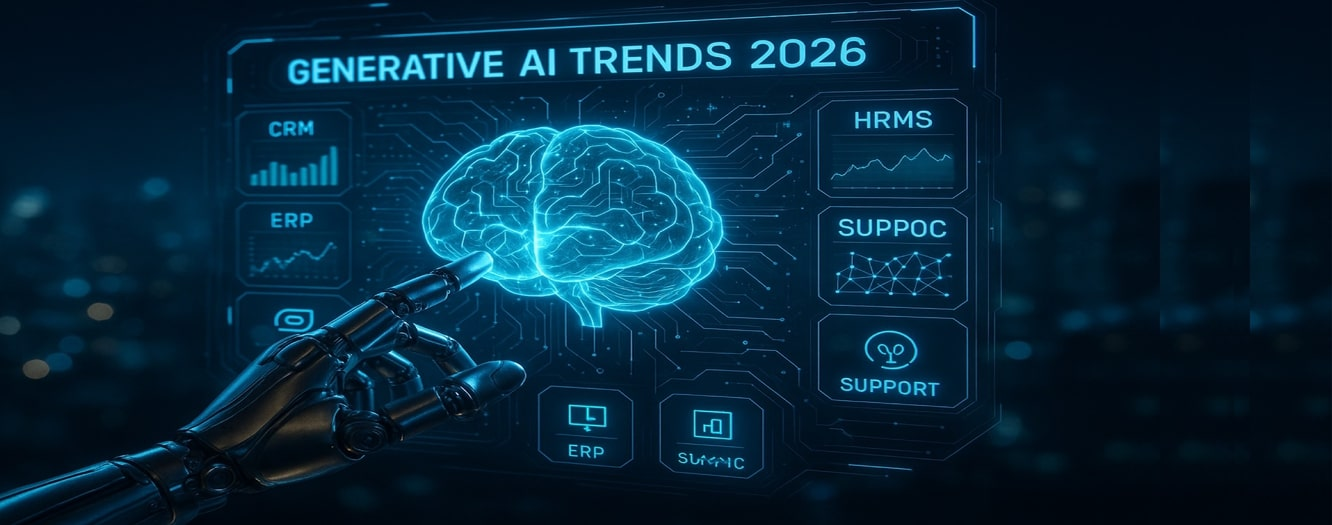
The corporate world has moved past the era of “AI experimentation.” In 2024 and 2025, many organizations were content with “wrapping” existing Large Language Models (LLMs) into basic internal tools. However, as we cross into the second quarter of 2026, the market has matured. Today, the true competitive advantage belongs to the “Architects of Intelligence”, those who leverage generative AI development services to build bespoke, agentic ecosystems that own their data and their destiny.
For the modern CEO, the question is no longer about the capabilities of AI, but about the ownership of the output. This shift has placed a premium on the partnership between an enterprise and a custom AI development company, moving away from “off-the-shelf” dependency toward proprietary technical wealth.
The Shift from Prompting to Engineering
In the early days of the generative boom, “prompt engineering” was hailed as the must-have skill. While still relevant, 2026 has seen a shift toward Systemic AI Engineering. Businesses have realized that a well-crafted prompt cannot compensate for a lack of specialized architecture. Generative AI development services now focus on building “Agentic Workflows”—autonomous systems that don’t just generate text but reason through multi-step business processes.
These systems are characterized by three core technological pillars:
- Retrieval-Augmented Generation (RAG) 2.0:Moving beyond simple document search to deep, cross-functional data synthesis that pulls from real-time ERP and CRM streams.
- Fine-Tuning at Scale:Taking foundational models and distilling them into “Small Language Models” (SLMs) that are hyper-accurate in specific domains like medical diagnostics or high-frequency legal auditing.
- Multi-Modal Orchestration:Integrating voice, vision, and text into a single cohesive interface, allowing for “Physical AI” applications in logistics and manufacturing.
The Role of AI Strategy Consulting in 2026
If development is the engine, then AI strategy consulting is the GPS. Without a clear strategic framework, generative projects often fall into “Pilot Purgatory,” where impressive demos fail to translate into bottom-line growth.
A senior strategist in 2026 focuses on the “Value-to-Risk” ratio. They ask: Where can generative AI create a 10x improvement in efficiency without introducing a 10x increase in liability? This involves:
- Data Readiness Audits:Assessing if a company’s data is “clean” enough to train or ground a model without introducing significant bias or hallucinations.
- Ethical Governance Frameworks:Implementing transparent auditing trails that satisfy the increasingly stringent global AI regulations, such as the 2026 updates to the EU AI Act.
- Workforce Augmentation Roadmaps:Planning for a future where AI handles the quantitative “drudge work,” allowing human capital to pivot toward high-level creative and emotional intelligence tasks.
Beyond Chatbots: The Rise of the Custom AI Development Company
A custom AI development company today acts as an extension of a firm’s R&D department. They are building “Digital Twins” of corporate knowledge. Instead of using a generic tool that learns from the entire internet, these companies build models that learn exclusively from your company’s best performers, your successful historical contracts, and your proprietary research.
This level of customization creates a “Flywheel Effect.” The more your custom AI is used, the more accurate it becomes for your specific context. Unlike a subscription to a third-party LLM provider—where your payments effectively subsidize the training of a model your competitors also use—investing in custom development builds a private asset that appreciates in value over time.
Vertical-Specific Generative Solutions
We are currently seeing the explosion of “Vertical GenAI.” This is where generative AI development services are tailored to the unique vernacular and regulatory constraints of specific industries:
- Legal & Compliance:Custom models that can “read” 1,000-page contracts in seconds to identify hidden liability clauses based on a firm’s specific risk tolerance.
- Pharmaceutical R&D:Generative models that assist in protein folding and molecular design, shortening the “hit-to-lead” time in drug discovery by years.
- Hyper-Personalized Marketing:Moving past “First Name” tags to AI that generates unique video advertisements and product descriptions for every individual customer based on their specific browsing psychology.
Technical Wealth and the “Legacy of the Future”
Many organizations fear the initial capital expenditure of custom development. However, senior content strategists and financial officers now view this through the lens of Technical Wealth.
When you rent an AI tool, you are incurring a form of digital rent. When you build a custom solution through a dedicated developer, you are building equity. In 2026, a company’s valuation is increasingly tied to the sophistication of its proprietary AI stack. Those who rely solely on public models are seen as high-risk, as they lack the “moat” that specialized, in-house intelligence provides.
The Human Element: Co-Piloting the Future
The most successful implementations of generative AI aren’t those that replace humans, but those that empower them. Through expert AI strategy consulting, businesses are learning to design “Human-in-the-Loop” systems. These systems provide the “First Draft” of everything—from code to creative briefs—allowing human experts to spend 90% of their time on the “Last Mile” of refinement and quality assurance.
This shift is significantly reducing burnout in high-pressure industries. By automating the high-volume, low-context tasks, generative AI is actually making work more “human” again, focusing on relationship-building and complex problem-solving.
Conclusion: Embracing the Bespoke Intelligence Era
As we progress through 2026, the divide between the “AI adopters” and the “AI innovators” will become a chasm. Adopting AI is no longer enough; you must own the intelligence that drives your business.
By leveraging professional generative AI development services, engaging with forward-thinking AI strategy consulting, and partnering with a specialized custom AI development company, you aren’t just following a trend. You are constructing a resilient, intelligent foundation that will define your market leadership for the next decade. The era of the generic bot is dead; the era of bespoke, enterprise-wide intelligence has arrived.
FAQ
- What makes generative AI development services different from standard software development?
Standard software follows “if-then” logic, whereas generative AI development involves training probabilistic models to create new content or reasoning. This requires specialized skills in data science, neural network architecture, and continuous reinforcement learning, making it a much more dynamic and evolving process than traditional coding.
- How does a custom AI development company handle data privacy and security?
In 2026, security is paramount. Custom developers build models that reside within your private cloud or on-premise infrastructure. This ensures that your proprietary data never leaves your secure perimeter to train external models, protecting your intellectual property and ensuring compliance with global privacy laws.
- Why should we invest in AI strategy consulting before building our first custom model?
Building AI without a strategy is an expensive mistake. Strategy consulting identifies the highest ROI use cases, ensures your data infrastructure is prepared for AI, and creates a roadmap for user adoption. This prevents “feature creep” and ensures that your AI investment directly supports your core business objectives.
- Can generative AI truly integrate with my existing legacy business systems?
Yes, but it requires a specialized approach. Modern generative services use “API-first” architectures and sophisticated data connectors to “read” from legacy databases. This allows the AI to provide insights based on decades of historical company data without requiring a total overhaul of your existing software infrastructure.
- What is the typical timeframe for seeing a ROI from custom generative AI development?
While foundational development can take 3 to 6 months, most enterprises see a “Productivity ROI” almost immediately after deployment. Full financial ROI, measured in cost savings and new revenue streams, typically manifests within the first 12 to 18 months as the model matures and scales across the organization.